
Day of the Dead - Día de los Muertos
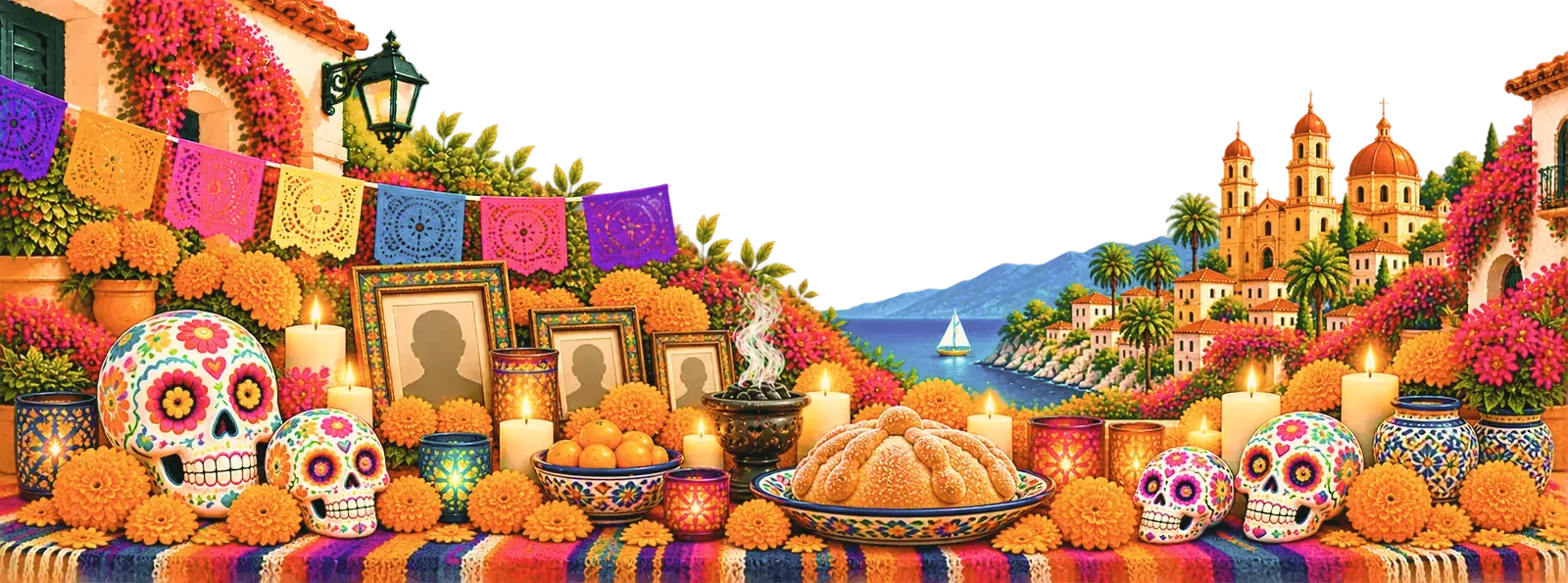
Beginner Spanish · Día de los Muertos
Día de los Muertos in Spanish
Día de los Muertos is a Mexican tradition centered on remembering and honoring loved ones who have died. This lesson focuses on respectful language for talking about ofrendas, photographs, candles, flowers, traditional items, and remembrance.
Your next small win: name common Día de los Muertos items, describe a simple ofrenda, use recordar and honrar, and ask respectful questions about photographs and traditions.
Start with the key symbols
Core Día de los Muertos Vocabulary
These words help you recognize some of the most common items connected with Día de los Muertos.
Day of the Dead
Offering / remembrance display
Altar
Candle
Marigold
Photograph
Name four important items
Say “ofrenda, candle, marigold, and photograph” in Spanish.
Ofrenda, vela, cempasúchil y fotografía.
More traditional items
Bread of the Dead
Sugar skull
Decorated skull
Decorative cut paper
Flowers
Favorite food
Describe what you see
Talking About an Ofrenda
An ofrenda may include photographs, candles, flowers, food, drinks, and personal objects connected with the person being remembered. The exact traditions can vary between families and regions.
We prepare an ofrenda for our loved ones.
We decorate the ofrenda with marigolds.
There are photographs on the ofrenda.
There are candles and flowers.
Papel picado decorates many ofrendas.
Pan de muerto is a traditional food associated with this celebration.
Useful pattern: use hay to describe what is present: Hay fotografías, Hay velas, Hay flores.
Talking about an ofrenda
The ofrenda is very beautiful.
Thank you. We prepare it to remember our grandparents.
Whose photographs are these?
They are photographs of our loved ones.
Describe an ofrenda
Say that there are photographs, candles, and marigolds on the ofrenda.
Hay fotografías en la ofrenda.
Hay velas y flores de cempasúchil.
Talk about remembrance
Recordar and Honrar
Two useful verbs in this lesson are recordar, to remember, and honrar, to honor.
To remember
To honor
Loved ones
Memory / remembrance
We remember our loved ones with love.
We light candles in memory of our loved ones.
Useful expression: en memoria de means “in memory of.”
Talk about remembrance
Say that you remember loved ones with love and light candles in their memory.
Recordamos a nuestros seres queridos con amor.
Encendemos velas en memoria de nuestros seres queridos.
More remembrance vocabulary
Family
Cemetery
Celebration
To visit the cemetery
Ask and learn respectfully
Useful Questions About the Tradition
These questions help you learn about an ofrenda and the celebration without assuming that every family follows the same customs.
When is Día de los Muertos celebrated?
What do they put on the ofrenda?
What do the marigolds symbolize?
Whose photograph is this?
Whose photographs are these?
Do you visit the cemetery during the celebration?
Cultural note: Día de los Muertos is traditionally observed in Mexico and by Mexican communities elsewhere. Customs vary between families and regions. Although skull and skeleton imagery is common, the tradition has a different cultural meaning from Halloween.
Ask about an ofrenda
Ask what people put on the ofrenda, whose photograph you are looking at, and what the marigolds mean.
¿Qué ponen en la ofrenda?
¿De quién es esta fotografía?
¿Qué significan las flores de cempasúchil?
Your turn · 8 quick questions
Practice: Día de los Muertos
Choose the answer that best fits each situation. Focus on ofrendas, traditional items, photographs, remembrance, and respectful questions.
Practice complete
You can talk respectfully about Día de los Muertos in Spanish.
A few Día de los Muertos phrases to revisit
One last step: describe an ofrenda without choices.
Name three items you might see, say why the ofrenda is prepared, and ask whose photograph is on it.
Hay fotografías, velas y flores de cempasúchil.
Preparamos la ofrenda para recordar a nuestros seres queridos.
¿De quién es esta fotografía?
Which Spanish word refers to the remembrance display prepared for Día de los Muertos?
- ofrenda
- cementerio
- recuerdo
- celebración
Ofrenda refers to the offering or remembrance display associated with the celebration.
ofrenda
Which word means “marigold” in this lesson?
- cempasúchil
- calavera
- vela
- fotografía
Cempasúchil is the marigold associated with Día de los Muertos.
cempasúchil = marigold
You want to say that you decorate the ofrenda with marigolds. Which sentence fits?
- Decoramos la ofrenda con flores de cempasúchil.
- Preparamos la ofrenda con fotografías.
- Encendemos velas en la ofrenda.
- Recordamos a nuestros seres queridos con amor.
Decorar con means “to decorate with.”
Decoramos la ofrenda con flores de cempasúchil.
You want to say that you remember your loved ones with love. Which sentence fits?
- Recordamos a nuestros seres queridos con amor.
- Decoramos a nuestros seres queridos con flores.
- Visitamos a nuestros seres queridos con velas.
- Preparamos a nuestros seres queridos con fotografías.
Recordar means “to remember,” and seres queridos means “loved ones.”
Recordamos a nuestros seres queridos con amor.
You want to ask what people put on the ofrenda. What do you ask?
- ¿Qué ponen en la ofrenda?
- ¿Quién prepara la ofrenda?
- ¿Dónde está la ofrenda?
- ¿Cuándo decoran la ofrenda?
¿Qué ponen en la ofrenda? means “What do they put on the ofrenda?”
¿Qué ponen en la ofrenda?
You want to ask whose photograph this is. What do you ask?
- ¿De quién es esta fotografía?
- ¿Dónde está esta fotografía?
- ¿Qué significa esta fotografía?
- ¿Cuándo ponen esta fotografía?
¿De quién es...? asks who something belongs to.
¿De quién es esta fotografía?
Which phrase means “sugar skull”?
- calavera de azúcar
- papel picado
- pan de muerto
- flor de cempasúchil
Calavera de azúcar means “sugar skull.”
calavera de azúcar = sugar skull
You want to ask when Día de los Muertos is celebrated. What do you ask?
- ¿Cuándo se celebra el Día de los Muertos?
- ¿Dónde se celebra el Día de los Muertos?
- ¿Cómo decoran el Día de los Muertos?
- ¿Qué ponen en el Día de los Muertos?
Cuándo asks about time, so ¿Cuándo se celebra...? asks when the celebration takes place.
¿Cuándo se celebra el Día de los Muertos?